
Technology
The Retention Ontology System
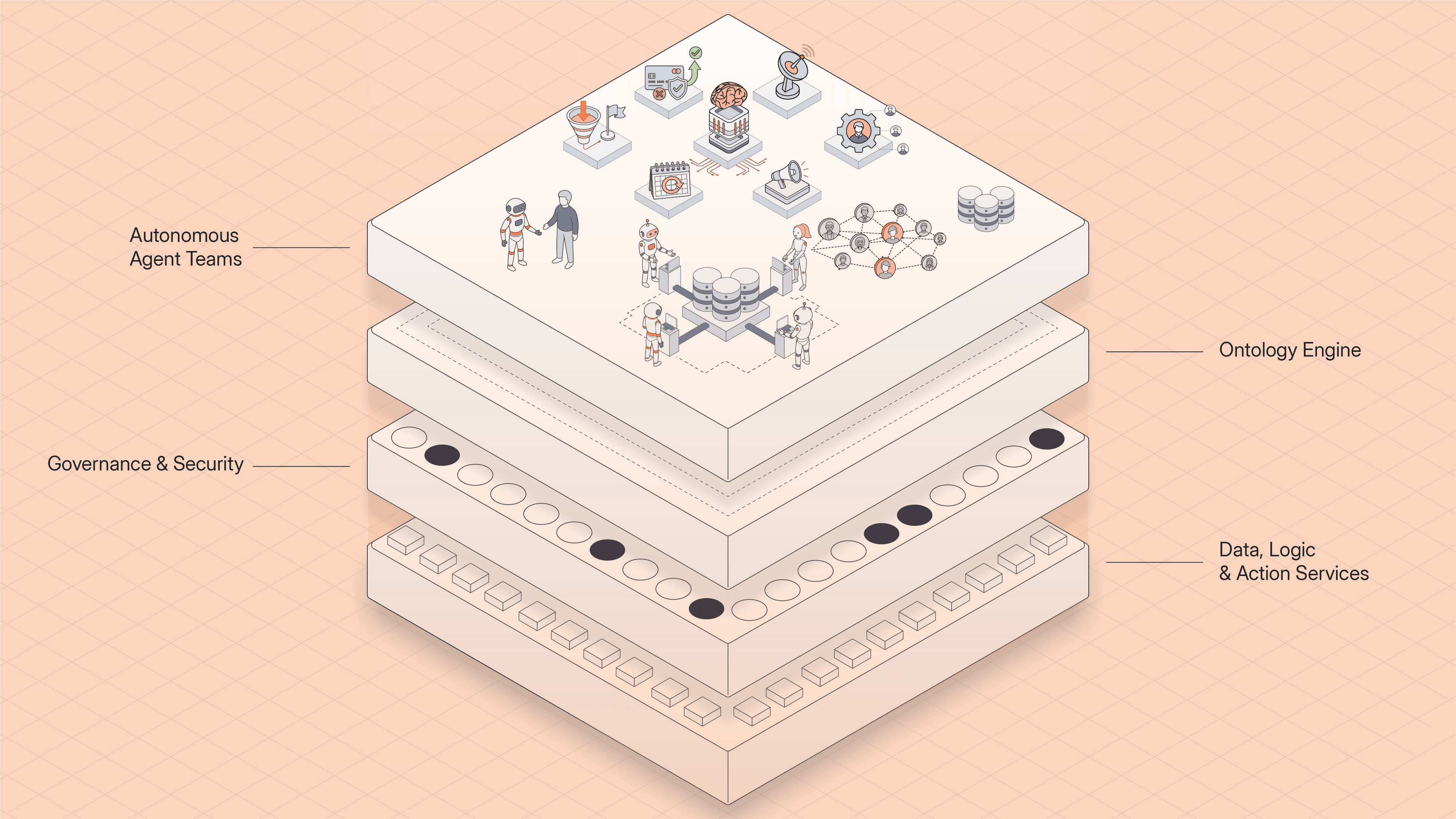
Swivel's Retention Ontology System is a single model of your retention operation. It holds the data, the decision logic, the actions your team can take, and the governance over those actions, letting a combined Human + AI team run retention as one coordinated system instead of a stack of disconnected tools.
What it is
Most retention stacks are a patchwork: a churn dashboard in one place, billing in another, a messaging platform in a third, with people manually carrying context between them. The Retention Ontology System replaces that patchwork with one model. It holds a live representation of your customers and how they relate to one another (the ontology), a layer that decides what to do about them (the decision layer), a library of governed moves your team and its agents can make (the action layer), and the rules and sign-off that keep every customer-facing move under human control (governance). This Ontology System powers the agent teams that run your retention plays end-to-end.
The four pillars
The System is organized around four pillars. Each has its own page in this section.
- Data: The Retention Ontology. A live, connected model of every customer, subscription, payment, and behavior. → The Retention Ontology
- Logic: The Decision Layer. Where the ontology becomes judgment: who is at risk, why, and which move fits. → The Decision Layer
- Action: The Action Layer. The governed library of retention moves your team and agents share. → The Action Layer
- Governance: Human-in-the-Loop. The rules and approvals that keep every customer-facing move under your control. → Governance & Human-in-the-Loop
Why an ontology
An ontology is a working model of a business: its nouns, the relationships between them, and the actions that can be taken on them, all represented explicitly. Swivel applies that idea to retention. Your customers, subscriptions, payments, and behaviors become objects; the relationships between them become links; and the moves your team can make become actions. Because both your people and Swivel's agents reason over the same shared model, they share one picture of reality instead of trading exports and screenshots. The model has two halves: a semantic half that describes what exists (objects, properties, links) and a kinetic half that describes what can be done (actions, permissions, audit).
How a decision moves through the System
The four pillars work as a loop. Take a failed payment:
- Data: the payment failure lands in the ontology. The Payment object updates, and the customer's risk is recomputed against their own history.
- Logic: the decision layer flags the account and proposes the move that fits this customer and this moment.
- Action: the System assembles the matching action, such as a payment-recovery sequence, ready to run.
- Governance: your policy decides what happens next: recovery attempts inside your set limits can run on their own; anything outside them waits for a person's sign-off.
- The outcome is written back to the ontology, so the next decision is made on better information.
That loop is the whole product. Everything in this section is a closer look at one part of it.
Let the agents prove themselves on your accounts.
In three weeks, see the saves they worked, the reasoning behind each action, and what happened before you decide what comes next.